The Galáctico Gamble: Real Madrid’s Turn-of-the-Millennium Supernova
The Galáctico era at Real Madrid was a revolution disguised as a circus act. It was a blockbuster project born from the mind of Florentino Pérez, a man who thought in advertising slogans and signed cheques like a bored oil baron. His philosophy was straightforward: gather the world’s most marketable players, put them in the same dressing room, and watch the magic happen.
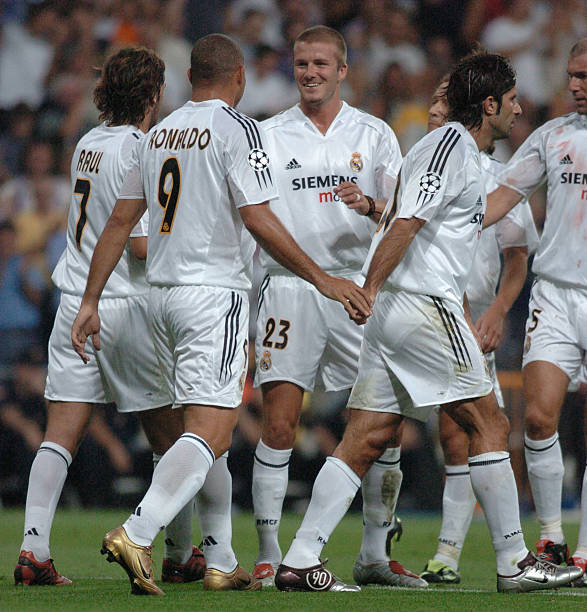
At its core, it was a marketing strategy dressed in white Adidas kits. But for a few glorious years, it also worked.
In 2000, Pérez took over the presidency of Real Madrid and immediately broke football’s transfer record to sign Luís Figo from Barcelona. The betrayal set Catalonia on fire and marked the beginning of something bigger than just a transfer, it was the start of an ideology. One superstar would arrive every summer. Zinedine Zidane came next, in 2001, plucked from Juventus in exchange for a Picasso-worthy €77.5 million. Ronaldo followed in 2002, fresh off a World Cup Golden Boot. David Beckham rounded things off in 2003, bringing Hollywood to the Bernabéu.
They weren’t just players, they were brands. Their shirts sold in airport duty frees and backstreet markets from Bangkok to Bogotá. You could write your name in glitter on the back of a number 23 and sell it for £50. Real Madrid weren’t just a football club anymore - they were an entertainment empire, one Stepford press conference away from announcing a feature film.
But beyond the merchandise stands and the glossy magazine covers, there was football. And at its peak, it was dazzling. Zidane’s volley in the 2002 Champions League final against Bayer Leverkusen was Michelangelo with laces. Figo’s crosses, Ronaldo’s bursts, Roberto Carlos tearing down the wing like a heat-seeking missile. When it clicked, it looked like football had been solved.

But this was never built to last. Pérez, obsessed with star power, famously let Claude Makélélé leave because he wasn’t glamorous enough. "He won’t be missed," was the message. In reality, he was the gravitational core, the engine oil, the glue that held the madness together. The dressing room grew bloated. Hierarchies dissolved. Ego filled the vacuum.
By 2004, it was unravelling. Beckham and Ronaldo were better on posters than pitches. Zidane was ageing. Figo left. The team won nothing in the final three years of the original Galáctico project, unless you count PR battles and red carpets.
And yet, despite the chaos, the Galáctico era remains unforgettable. Not because it worked consistently, but because it dared to be spectacular. It was football’s answer to pop art - impractical, flamboyant, brilliant for a moment.
It changed everything. Today, when clubs unveil new signings with choreographed TikToks and drone footage, you can trace the DNA back to Pérez’s vision. He didn’t just want a team to win games. He wanted the most famous team in the world to win the future.
And for a while, they did.

Written by TSPN Calcio